+254797 813499

Posted by OAY Kenya on 15-Mar-2026
Annual Floods. Biannual Shock. Zero Action. Kenya is underwater as scheduled.
BY FAITH NDANU.
“HEY, MMESWIM HUKO KWENU AMA MKO SAWA?”
This is not one of those stories that gives hope or makes demands. Neither is it a bunch of statistics meant to show the severity or exaggerate the efforts that we are putting in to survive. This is a story about our reality, about how we cling to irony and laughter to lighten the mood and the impact of rainfall and poor planning. This is a story of a country that is competing with Atlantis to see which one can go underwater faster. This is a story of a country that floods every year when the rains come, and somehow, nothing ever changes. This is a story that revolves around that question at the beginning. That question has to have been the most asked amongst family and friends this last month, and more so the last week. That question is an ironic check-in that translates to “are you guys swimming at your place or are you okay?” This irony is in reference to the floods that have converted houses in Nairobi and other parts of the country into waterfront properties.
Last Friday evening, I stepped off the pavement outside my house and into water. There was no kerb or road; there was only water, brown, insistent, and cold, swallowing a road that had been a road that very morning. I had walked that very road on my way to work that morning, complaining of all the potholes and the hooting matatus, and the mama mboga I buy tomatoes and fruits from was enthusiastically starting her day. I guess my complaints were too loud, and the skies decided a downpour solves all my problems; no visible potholes and no matatus hooting as they fly by.
By evening, the road had currents. Not puddles. Not the mild inconvenience of wet shoes and a bad mood. Currents. The kind that push back. The kind that wrap around your legs like something alive and remind you — quietly, firmly, without room for debate to either go back or ensure your stability is outstanding. The kind of currents that speak, threaten and if the current death toll of 49, according to Citizen TV, is anything to go by, water that consumes lives and displaces families.
Growing up, our parents told us stories. You know the ones. Stories of swimming across crocodile-infested rivers in the dark to get to school. Of climbing mountains barefoot in the rain to sit in classrooms with no roofs because education was worth any terrain, any weather, any obstacle the landscape could invent. They told us these stories with the specific gravity of people who needed us to understand that suffering had once been the price of a future. We sat there, warm, dry, mildly guilty — and quietly suspicious that the rivers got wider, the mountains got steeper with every retelling and some of our parents couldn’t actually swim. Instead, we nodded and promised ourselves we would take nothing for granted. Now here we are, wading through Nairobi on a Friday evening, knee deep in a river that used to be a road, already composing the story we will tell our own children.
"When I was young," we will say, "I swam through Nairobi to get home from work."
The difference is, our stories will be true and not fictional ones meant to convince a child to stay in school or learn to appreciate what they have. The irony does not need a punchline. We are the punchline.
We Asked the Rivers What They Could Do. They Said Hold Our Fish.
Let’s take a minute to appreciate the journey of how we got here, and not in the abstract language of policy papers and environmental assessments. Let’s put up a mental documentary of all the small and big choices we made that led us to forcibly take swimming lessons, row make-shift boats in the SEABD and hold hands in water to escape sinking vehicles. Nairobi was built on rivers. The Nairobi River. The Mathare. The Ngong. They were here before the city, before the tarmac, before the roundabouts, the overpasses and the flyovers. They had their own routes, their own logic, their own ancient understanding of where water was supposed to go.
Then the city came, fast, unrelenting, inconsiderate of the blueprints nature already had in place. We looked at the rivers, and we said — What exactly can you do to us? We paved over them, built on their banks and redirected them into drainage channels we designed for a city a quarter of this size. We handed the rivers a tender and told them to behave. We forgot that nature does not take orders from humans. The rivers said nothing except hold our fish and brace for impact. Every single year, without fail, without exception, without the courtesy of a warning we hadn't already been given, the rivers come back. They remember the blueprint we ignored, they recall the roads they used to take to get home, no shortcuts and no intention to follow the instructions we gave them.
Nairobi's matatus are now submarines, commuters are now swimmers, and somewhere, a bodaboda rider is attempting to cross what was a roundabout this morning with the quiet, admirable confidence of a man who has absolutely no idea how deep it gets on the other side. This is a wonderful time, incidentally, to take swimming lessons, invest in a boat, or — if you are feeling particularly committed to this new aquatic chapter of urban life — a pair of flippers. Deep divers have better infrastructure for this than the city currently does. At this rate, we might have hippos and crocodiles roaming the CBD by Thursday. Which would at least solve the traffic problem, I mean, nobody cuts off a hippo.
A Language We Cannot Understand, but a Knife to the Throat Needs No Translation.
My mother has a saying about water. She says water is life. Water is life, she says, but water is also angry. It does not care about life. It moves like a wounded animal, looking for something, anything, to share its pain with. Then she says the thing that stays with me: water speaks a language we cannot understand, but a knife to your throat surely does not need translation. Standing knee deep on that road on Friday, I understood her completely. The water was not making a speech. It was not protesting, petitioning, or asking to speak to the manager. It had moved past all of that. It was simply — and with a terrifying kind of calm — present. Water, like consequences, does not get louder as a warning. It just gets closer, and by the time you feel it at your knees, the warning has already been given. Several times, several years in a row, with the same footage, the same gumboots and the same investigations that find the same answers and recommend the same actions that produce the same results, which is to say — none, we hope that the coming year will be different.
Look at Us. Now Look at the Room.
This is the part the story was always building toward. Not the floods. Not the tenders. Not the satellite images of brown water where brown roads used to be. Not even the hippos — though we should not rule them out.
This is about who gets to decide what happens next.
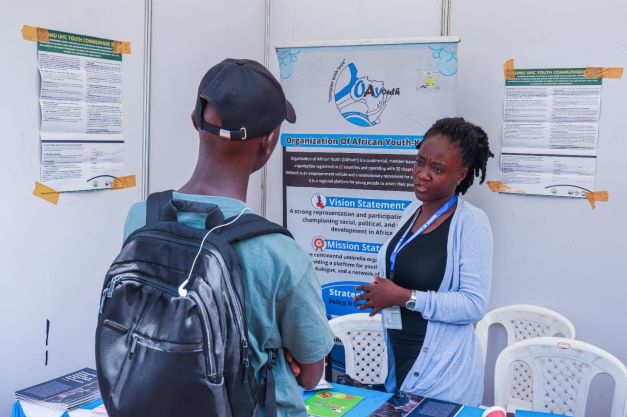
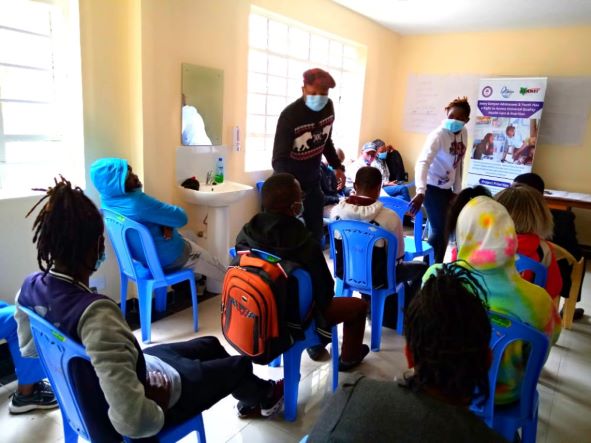
This week, while parts of Nairobi were busy becoming Venice — minus the romance, plus the existential dread — something else was happening. From Wednesday, at the People's Dialogue Festival, The Organization of African Youth-Kenya was gathering voices, collecting testimonies and building, brick by brick, the Youth Climate Manifesto. This manifesto is intended to be a living document that is not about what governments should do in theory, but about what young people are demanding in practice, from their experience of living inside a climate crisis that was not of their making.
Because the people most affected by these decisions have spent too long watching decisions get made without them.
The young woman who waded through floodwater to get to her exam on Friday did not cause this flood, but she will live inside the policy — or the absence of policy — that determines whether next year's flood is worse. The young man whose family's home flooded in Kisumu did not design the broken drainage system, but he understands, with the clarity that comes from cold water in your living room, exactly what a functional one would mean.
Their voices belong in the manifesto. Your voice belongs in the manifesto.
Not because it is symbolic, but because the quality of the decisions made in climate policy rooms is directly proportional to who is in those rooms. A drainage system designed without the input of the people who use it will fail them. A climate manifesto written without the voices of those living the crisis is not a manifesto — it is a memo from a meeting nobody affected was invited to.
The Youth Climate Manifesto is being built right now — from voices like yours, from experiences like Friday evening on a tarmac road that became a river, from the fury, the wit and the determination of a generation that has inherited a flooded city and is refusing to simply swim in circles.
Add your voice. Make your presence felt. Show up — dry if possible, but show up either way. The manifesto being written today will shape the rooms where tomorrow's decisions are made, and if the right people are not in those rooms, the water will answer for us. It has always been very good at getting the last word.
Our parents swam rivers — some of them suspiciously wide, some of them mysteriously uphill — so that we could sit in classrooms and build futures. We are swimming in tarmac so that our children hopefully do not have to. This can only be the reality if the right people are in the room when we decide to finally rebuild our nation.
The knife is at the throat.
No translation required.
Your voice is.
© 2026 Organisation Of African Youth | All Right Reserved.
Powered By Elvan Technologies


.jpg)
-fotor-2026072113348.png)


0 Comments