+254797 813499

Posted by OAY Kenya on 02-Sep-2026
We all know of that exhaustion that comes with being invited to rooms, sitting in panels, signing your name on a piece of paper and remaining powerless to what happens after we leave the room or press the red button on a virtual meeting. That tiredness is what the Youth GREEN Manifesto was built around and seeks to put an end to.
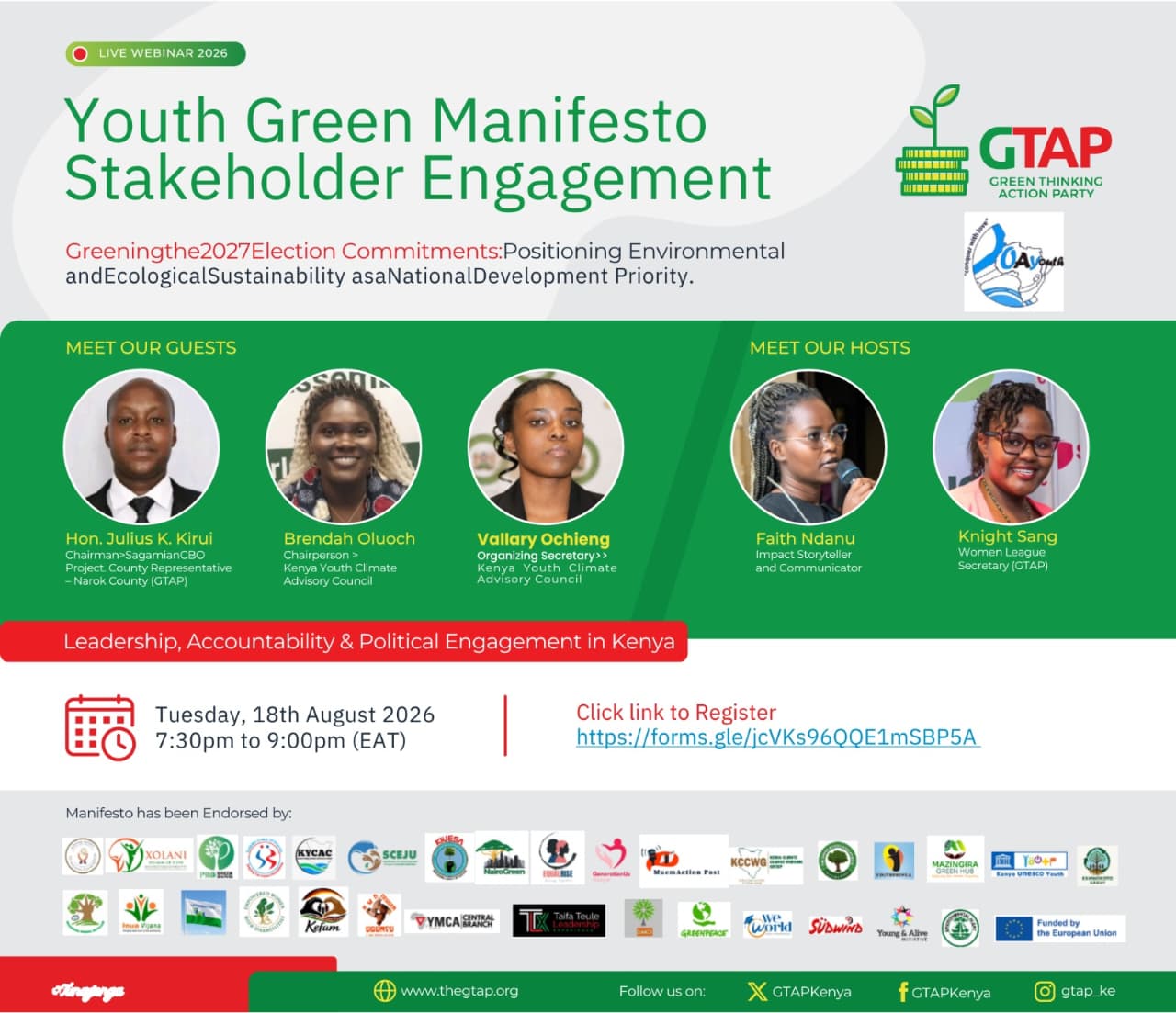
On the evening of 18 August 2026, that answer left the page and walked into a room — virtually, but no less real for it. For nearly two hours, the Organization of African Youth sat across from the Green Thinking Action Party, a political party that has staked its identity on green principles, and asked a question Kenyan youth have been asking for years without quite getting a straight reply: when you write your manifesto for 2027, will we actually be in it?
The Youth GREEN Manifesto did not begin as a document. It began as a pattern we finally decided to name out loud — young people being consulted endlessly and reflected in outcomes rarely. So OAY did something deliberately slower and harder than issuing a statement: it went and listened. Communities were engaged. Young people's lived experiences of climate change — the failed rains, the shrinking farms, the anxiety of not knowing what next season holds — were gathered, synthesised, and shaped into four pillars that now carry real political weight.
Climate financing that reaches the grassroots, not just the institutions that write the best grant proposals. Meaningful participation that means influence, not attendance. Green skills and jobs that give young people a stake in the economy they're being asked to help save, and gender equality and inclusion, because the weight of climate change does not fall evenly — it lands hardest on women, girls, children, and the people already carrying the most.
What made this particular evening different was who was in the room. GTAP is not a youth network or an NGO — it is a registered political party, with sitting representatives, county coordinators, and an actual shot at writing a manifesto that Kenyans will vote on. When Hon. Dominic Mwamisi and Hon. Julius Kirui sat in that virtual room, the conversation stopped being aspirational and became a negotiation.
Brenda Olouch, Chairperson of the Kenya Youth Climate Advisory Council, put something sharper on the table: a proposed amendment to the Political Parties Act that would legally require every party and aspirant to build environmental sustainability into their manifesto. It is, at its core, an argument about fairness across time — that the people who will live longest with today's political choices deserve a say in shaping them now, not a seat at the table after the damage is already done.
If there was one thing this room refused to accept, it was the familiar rhythm of climate advocacy in Kenya — loud before an election, silent after it. Participants spoke candidly about that fatigue, about watching urgency evaporate the moment the campaign season ends. So instead of leaving it to hope, they started sketching the infrastructure to prevent it: youth advisory structures that outlast election cycles, participatory budgeting, public tracking of whether the promises made on the campaign trail actually survive contact with government.
There was something else in the room too — a quieter, more practical honesty. A good idea, on its own, changes nothing. Political parties need language that speaks in policy. Communities need language that speaks in lived reality. Young people need language that speaks in their own register. Translating between these worlds is unglamorous work, and it is the work this manifesto now demands.
What left this room is not a finished victory — it's a mandate. Get the Youth GREEN Manifesto into the hands of political parties before 2027, push the Political Parties Act amendment forward, and build the mechanisms to hold every promise accountable long after the ballots are counted. It also means young Kenyans learning to ask sharper questions before they vote — not just who is running, but what a party actually believes, what economic model it stands behind, what it is willing to commit to when the climate conversation gets uncomfortable.
A manifesto is only ever a promise on paper. What this room made clear is that this generation of young Kenyans no longer intends to let promises stay there.
By Faith Ndanu

© 2026 Organisation Of African Youth | All Right Reserved.
Powered By Elvan Technologies

.jpg)
-fotor-2026072113348.png)
0 Comments